

A walk in the forest improves mental health.
August 2023 - by Molly McDonough
Harvard Medicine
Many doctors prescribe spending time in nature as a balm for the brain.
When a patient visits Dr. Daphne Miller, MD '93, from California, they sometimes leave with a prescription that seems a little unconventional.
The prescription doesn't come in a pill bottle and doesn't require insurance approval. And it won't have any negative side effects - apart from occasional sunburn or insect bites. Instead, it's something like this:
Damn: Time on the Richmond Bay trail. Dosage: 45 minutes. How to get there: Monday, Wednesday, Friday and Saturday, at 7am. Recharge: Unlimited.
Miller often prescribes doses of nature as part of broader treatment plans for mental health issues such as grief, depression, or anxiety. She insists that a tangible plan for spending time away from home can work wonders - and that she's not the only one who thinks so. "Nature's remedies are becoming increasingly popular," she says. "Many people are observing what nature does to their brains and finding objective data to prove it."
The cognitive benefits of spending time in nature.
Peter James is one of those people. James, an associate professor of population medicine at HMS in the Department of Population Medicine at the Harvard Pilgrim Health Care Institute, used data from the Nurses' Health Study – which followed a cohort of 121,000 women for decades – to explore the links between nature and health. By combining medical records with satellite data, James and colleagues found that women living in areas with more green spaces were 12% less likely to die during an eight-year follow-up period. As described in a 2016 article in Environmental Health Perspectives , This association was strongest for cancer and respiratory mortality.
James, who is also an associate professor of environmental health at the Harvard T.H. Chan School of Public Health, wondered why green spaces might reduce the risk of death. Was it because plants absorb pollutants from the air? Do people who live near parks exercise more? Analyzing the underlying mechanisms and controlling for factors such as socioeconomic status, he and his colleagues were surprised to learn that neither physical activity nor pollution levels explained the decrease in the mortality rate. Instead, mental health – measured as diagnosed depression or use of antidepressants – was the most important factor identified. Social engagement played a smaller but important role.
There is no pharmaceutical or precision medicine tool that can bring the broad benefits of a forest.
The research contributes to a robust body of evidence indicating that our brains benefit from getting out of the house. Studies comparing the mental health of participants after spending time in natural versus built environments have revealed physiological differences – such as reduced levels of salivary cortisol , a biomarker of stress, or reduced activity in brain regions involved in rumination. , a cycle of negative thoughts – between those who have spent time in nature and those who have not. Even being in indoor rooms with windows that allowed views of nature or contained natural features, such as plants, It has been associated with cognitive benefits.
The idea that we are somehow programmed to find solace in vegetation “isn’t rocket science,” says James, who now uses Google Street View imagery and deep learning algorithms to focus on the exact components of nature, such as the proportion of trees, grass, or flowers in a given area, that generate health outcomes. He emphasizes that the value of green spaces is present in many aspects of our lives, from property prices to spa soundtracks featuring nature sounds. The truth is that we are nature "He says." "We didn't evolve to sit in a windowless room staring at a computer screen." These artificial environments stress us out. They force us to focus more than we want and tire our cognitive function.”
Forest therapy
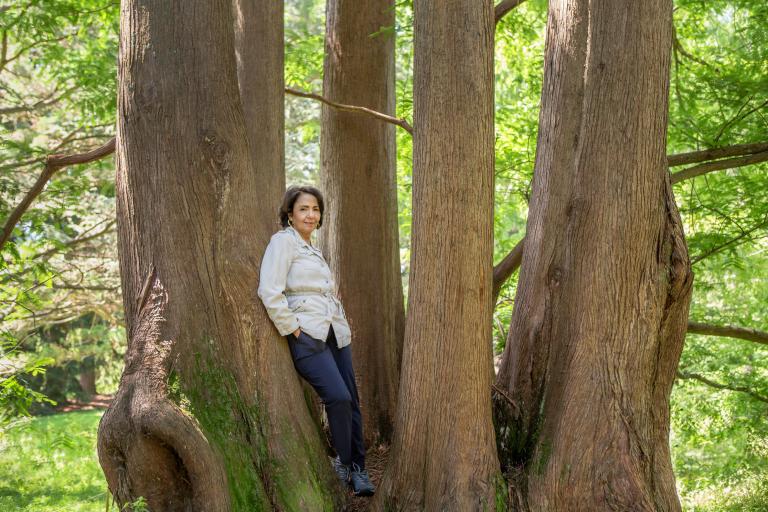
Susan Abookire, a doctor in '91, would agree. “We have evolved in our relationship with trees,” she says. “If we look at the science, we see how, for example, the aromatic compounds in the forest affect our immune system, or how dirt regulates the microbiome of our gut. "There is no pharmaceutical or precision medicine tool that can bring the broad benefits of a forest." - Susan Abroire
Nature is both a healer and a co-teacher for Abookire, an assistant professor of medicine at HMS in Brigham and Women's Hospital, who has spent her career designing complex healthcare systems. Several years ago, she began bringing students from her systems design courses on outdoor activities to explore the complexity of natural ecosystems. That's how she became interested in forest bathing, or shinrin-yoku — a therapeutic practice of Japanese origin that involves spending time in the forest. Since the Japanese government began promoting the practice in the 1980s, hundreds of studies They highlighted its link to improved mental health.
Abookire saw the potential of the practice to help his medical students and colleagues with a problem that permeates healthcare work: burnout. Then she obtained a certification in forest therapy.
Every month she brings groups of medical residents from Brigham and Women's to the verdant corners of Harvard University's Arnold Arboretum, located in Boston. She guides them to perceive the smells, sights, and sounds of the forest; to perceive the movements of plants; and feel connections with nearby trees.
Abookire says she is always impressed by the revelations that residents describe in the discussions that follow these walks and by the parallels with nature that they see in their own work: An erupting ecosystem from a dead tree recalls the cycle of life and death; The unexpected textures of plants reflect the importance of human touch in medicine. And the sessions give them a much-needed opportunity to reset and recharge. “Having the opportunity to truly become aware and embodied in our senses changes the neurobiology of our state of being,” says Abookire. "It activates the parasympathetic nervous system and kind of allows the other things to rest – all the things we do in the frontal cortex and the sympathetic nervous system."
Green space for everyone
However, you don't need a certified forest therapy guide – or even an entire forest – to reap the benefits of green spaces. “Even an urban park, even a small patch of grass is beneficial,” says Abookire, provided certain ingredients are present: the feeling that you have managed to escape from normal life and a natural element to focus your attention on. She points to a 2019 study in Frontiers in Psychology which allowed urban participants to choose the time, place and duration of their experiences in nature. Researchers found that even 20 minutes of these flexible “natural pills,” three times a week, produced benefits such as reduction of salivary cortisol levels .
“The ultimate goal isn’t to go to Yosemite,” James echoes. "Literature suggests that people thrive in cities and other places that have incorporated nature, vegetation, trees, and parks." What we really need to do is incorporate nature into everyday life.”
But even small patches of vegetation are difficult to find in some places. James hopes his research will encourage lawmakers and urban planners to design cities with more equitable access to green spaces. Studies suggest that Low-income neighborhoods reap even greater health benefits from green spaces. than the wealthy communities. “You might imagine that adding another amenity to a wealthy community won’t do much good,” he says, “but if you can add green spaces to places where they don’t exist, that could substantially benefit people’s health.”
“Anything we can do to bridge the green divide and create equality in green spaces will change health outcomes,” says Miller. The community of North Richmond, California, where she works, has some of the highest rates of chronic disease, homelessness, and poverty—as well as some of the lowest amounts of green space per capita—in the Bay Area. But she noted that even trips to the small park or urban farm near the clinic make a difference for patients.
"I personally would love for access to green spaces to be a vital sign," she says. "When patients arrive, we check their blood pressure and heart rate." Why don't we ask: 'Is there green space near your home where you can walk and enjoy yourself safely?'"
Molly McDonough is an associate editor at Harvard Medicine journal .
Images: fotoVoyager/E+/Getty Images (top); John Soares (Abookire)