

Ego Dissolution and Psychedelics: Validation of the Ego Dissolution Inventory (EDI)
Method Sixteen items related to altered ego consciousness were included in an online questionnaire; eight related to the experience of ego dissolution (comprising EDI) and eight related to the antithetical experience of increased self-confidence, termed ego inflation. The items were rated using a visual analog scale. Participants answered a questionnaire about their experiences with classic psychedelic drugs, cocaine, and/or alcohol. They also answered the seven questions of the Mystical Experiences Questionnaire (MEQ) related to the experience of unity with the environment.
Results : Six hundred and ninety-one participants completed the questionnaire, providing data for 1,828 drug experiences (1,043 psychedelics, 377 cocaine, 408 alcohol). Exploratory factor analysis demonstrated that the eight items of the EDI loaded exclusively on a single common factor, which was orthogonal to a second factor composed of items related to ego inflation (rho = −0.110), demonstrating discriminant validity. The EDI correlated strongly with the unitive experience measure derived from the MEQ (rho = 0.735), demonstrating convergent validity. The internal consistency of the EDI was excellent (Cronbach's alpha 0.93). Three analyses confirmed the specificity of ego dissolution for experiences induced by psychedelic drugs. First, the EDI score correlated with drug dose for psychedelic drugs (rho = 0.371), but not for cocaine (rho = 0.115) or alcohol (rho = −0.055). Secondly, the linear regression line relating the subjective intensity of the experience to ego dissolution was significantly steeper for psychedelics (unstandardized regression coefficient = 0.701) compared to cocaine (0.135) or alcohol (0.144). Ego inflation, on the other hand, has been specifically associated with experiences with cocaine. Finally, a binary Support Vector Machine classifier identified experiences induced by psychedelic drugs versus cocaine or alcohol with over 85% accuracy using ego dissolution and inflation classifications only. It was specifically associated with experiences with cocaine. Finally, a binary Support Vector Machine classifier identified experiences induced by psychedelic drugs versus cocaine or alcohol with over 85% accuracy using ego dissolution and inflation classifications only. It was specifically associated with experiences with cocaine. Finally, a binary Support Vector Machine classifier identified experiences induced by psychedelic drugs versus cocaine or alcohol with over 85% accuracy using ego dissolution and inflation classifications only.
Conclusion Our results demonstrate the psychometric structure, internal consistency, and construct validity of the EDI. Furthermore, we demonstrate the close relationship between ego dissolution and the psychedelic experience. EDI will facilitate the study of the neural correlates of ego dissolution, which is relevant to psychedelic-assisted psychotherapy and our understanding of psychosis.
Introduction
Distortions in one's subjective experience of the "self" or "ego" are central to the psychedelic experience. James, 1882 ; Huxley, 1954 ; Savage, 1955 ; Klee, 1963 ; Leary et al., 1964 ; Grof, 1976 , 1980 ; Harrison, 2010 ; Carhart-Harris et al., 2014 ; Lebedev et al., 2015 ). Specifically, a reduction in self-referential awareness that defines normal waking consciousness has been reported with all classic psychedelic drugs ( 5-HT receptor agonists 2A), including psilocybin ( Griffiths et al., 2008 , 2011 ), lysergic acid diethylamide (LSD; Goodman, 2002 ; Lyvers and Meester, 2012 ) and dimethyltryptamine (DMT; Trichter et al., 2009 ), as well as with other psychoactive substances, such as nitrous oxide ( James, 1882 ) and ketamine ( Vollenweider and Kometer, 2010 ).
The experience of a compromised sense of identity brought on by psychedelic drugs has been called ego death ( Grof, 1980 ; Harrison, 2010 ), loss of ego ( Leary et al., 1964 ) and disintegration of the ego ( Muthukumaraswamy et al. , 1964 ). 2013 ; Lebedev et al., 2015 ) and dissolution of the ego ( Klee, 1963 ; Studerus et al., 2010 ; Carhart-Harris et al., 2014 ; Lebedev et al., 2015 ; Tagliazucchi et al., 2016). ). This experience has been interpreted from a psychoanalytic perspective as a rupture of the ego's boundaries, resulting in a blurring of the distinction between self-representation and object representation, and preventing the synthesis of self-representations into a coherent whole (Federn, 1952 ; Savage, 1955 ; Fischman, 1983 ).
It is likely that the subject's prior "psychology" and the environment in which they ingest a psychedelic influence whether an ego-dissolving experience is welcomed and felt as something positive, or feared and resisted. Eveloff, 1968 ; Fischman, 1983 ; Griffiths et al., 2008 ; Studerus et al., 2010 , 2012 ). At one extreme, the dissolution of the ego is closely related to blissful mystical experiences, such as those that can be brought about by certain spiritual or religious practices ( Stace, 1960 ; Hood, 1975 ; MacLean et al., 2012 ); Indeed, the loss of self was identified by William James as a fundamental characteristic of mystical experience ( James, 1985). ). These experiences are characterized by a feeling of unity with the environment, which is explicitly related to disturbed ego boundaries and, therefore, to ego dissolution. Furthermore, the mystical experience is likely to be a therapeutic benefit in psychedelic psychotherapy ( Leary et al., 1964 ; Grof, 1980 ; Griffiths et al., 2008 , 2011 ; Johnson et al., 2008 , 2014 ). At the other extreme, it is argued that self-disturbances and disturbed ego boundaries are a central phenomenological feature of psychosis and schizophrenia ( Bleuler, 1950 ; Laing, 1959 ; Scharfetter, 1981 ; Fischman, 1983 ; Parnas, 2011 ; Sass et al., 2011 ; Northoff, 2014 ; Nour and Barrera, 2015 ), although it is not yet clear exactly how the specific self-disturbances of schizophrenia relate to the experience of ego dissolution under psychedelics.
Discussions about altered self-experience have traditionally been confined to philosophy or descriptive psychopathology. Stace, 1960 ; Jaspers, 1997 ). In recent years, however, there has been a growing interest in the neurobiological correlates of the experience of self ( Carhart-Harris and Friston, 2010 ; Qin and Northoff, 2011 ; Carhart-Harris et al., 2014 ). Psychedelic drugs may provide a fruitful avenue of research into the neural correlates of normal and abnormal self-awareness or ego consciousness ( Carhart-Harris et al., 2013 , 2014 ; Muthukumaraswamy et al., 2013 ; Roseman et al., 2014 Lebedev et al., 2015 ; Tagliazucchi et al., 2016 ). This research program, however, is based on the existence of a validated self-report measure of the ego dissolution experience.
Currently there are several measures that capture feelings related to changes in self-experience ( Strassman et al., 1994 ; Parnas et al., 2005 ; Studerus et al., 2010 ; MacLean et al., 2012 ). The Dittrich APZ (abnormal mental states) questionnaire and its revised versions, OAV and 5D-ASC, have been widely used to characterize altered states of consciousness caused by psychedelic drugs ( Dittrich, 1998 ; Studerus et al., 2010 ). These questionnaires aim to capture positive and negative experiences of depersonalization and derealization (“oceanic limitlessness” and “fear of ego dissolution,” respectively), as well as additional dimensions of “visionary restructuring” (in APZ, OAV, and 5D-ASC), “auditory alterations,” and “reductions in vigilance” (both only in 5D-ASC; Dittrich, 1998 ; Hasler et al., 2004 ; Wittmann et al., 2007 ; Studerus et al., 2010 , 2011 ; Schmid et al., 2015 ). Recent psychometric evaluation of the OAV questionnaire, however, reveals a more complex structure of 11 factors, including factors related to changes in cognition, perception, and mood, as well as feelings of unity and disembodiment. Currently, however, there are no validated scales that allow for an easy, reliable, and direct one-dimensional measurement of ego dissolution. This represents a barrier to this promising line of research.
The main objective of the present study was to develop and validate the "Ego Dissolution Inventory" (EDI), a novel, concise, 8-item self-administered questionnaire designed to operationalize the experience of ego dissolution so that its construct validity can be tested and developed. To do this efficiently, we opted to use online data collection through a large, anonymous internet survey. A secondary objective was to investigate the specificity of the relationship between the experience of ego dissolution and psychedelic drugs, compared to cocaine and alcohol. These two comparator drugs were chosen due to their wide availability and use in Western societies. Finally, we sought to test the hypothesis that experiences induced by classic stimulant drugs, such as cocaine, are in some respects antithetical to the psychedelic experience.
Materials and methods
Research construction
Selection of an item from the ego dissolution inventory.
Sixteen new statements related to the experience of ego consciousness were included in this study. Eight of them were designed to capture the central phenomenon of ego dissolution (and the associated feeling of heightened connection with the environment, known as dissolved ego boundaries), and particularly as it was characterized in the context of the psychedelic experience ( Leary et al., 1964 ; Grof, 1980 ; Harrison, 2010 ). In addition to referring to existing literature on the psychedelic experience, we also sought the opinion of six scientists working in the field of psychedelic neuroscience when choosing the final eight ego dissolution items and sought a consensus on the chosen items. The other eight items were designed to reflect the distinct and largely antithetical experience of extraordinarily high self-confidence and self-esteem (which we refer to as "ego inflation"). The items from these two subscales were included in the final survey in an alternating fashion with the intention of minimizing the "order" effects of the questions. and the potential tendency of subjects to indiscriminately endorse any claim about altered consciousness when reflecting on an experience with a psychoactive substance (particularly if that substance can have profound and varied psychological effects, as is the case with psychedelics). The items were evaluated using a visual analog scale format (0-100, with incremental units of one) with zero defined as “No, no more than usual” and 100 defined as “Yes, totally or completely”, drawing inspiration from a previous study. questionnaire on altered states of consciousness developed by Dittrich (1998) , as well as other self-built scales used internally by our team ( Carhart-Harris et al., 2012 , 2015 ; Muthukumaraswamy et al., 2013 ). For the exact wording of the 16 ego-awareness items included in the research, please refer to the Table. 1 .
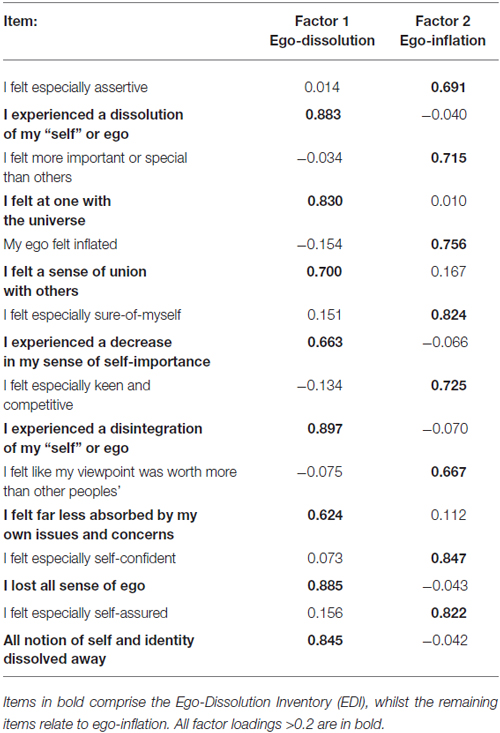
TABLE 1. FACTOR LOADINGS FROM THE EXPLORATORY FACTOR ANALYSIS OF ITEM SCORES FROM 1828 DRUG EXPERIENCES (EXTRACTION METHOD: PRINCIPAL AXIS FACTOR; ROTATION METHOD: PROMAX WITH KAISER NORMALIZATION; LOADINGS TAKEN FROM THE STANDARD MATRIX) .
Research Structure
Each subject was asked to provide information about their age, gender, and educational background. . Participants also provided information on their lifetime use of psychedelic drugs and cocaine, as well as their weekly alcohol consumption (all possible response options for education and drug and alcohol use are presented in the Table). 2 ).
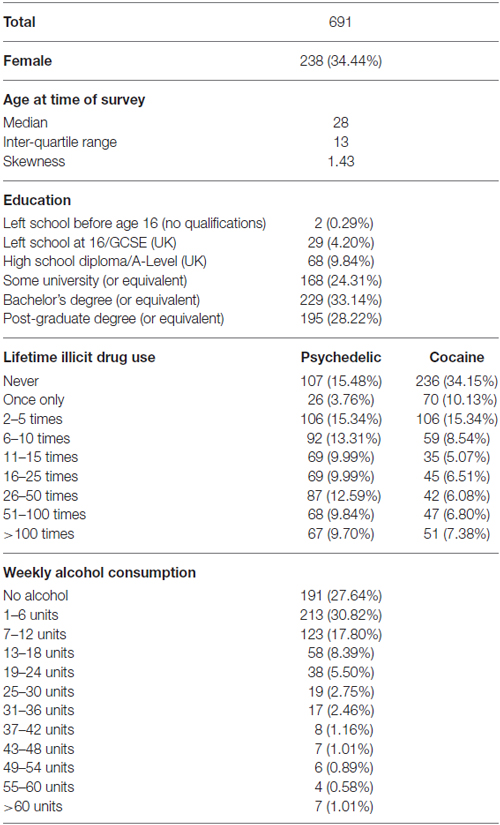
TABLE 2. DEMOGRAPHIC DATA OF INDIVIDUALS WHO PROVIDED INFORMATION ON AT LEAST ONE EXPERIENCE WITH DRUGS .
After providing this demographic data, participants had the opportunity to answer questions about up to four drug experiences: (1) their “most intense” psychedelic experience; (2) a “typical” psychedelic experience; (3) a “typical” experience with cocaine; and (4) a “typical” alcohol experience. For psychedelic experiences, subjects could further specify the drug ingested (the options were: LSD, psilocybin, mescaline, DMT, and ayahuasca). For each experience, participants were asked to provide information about how long ago the experience occurred (the options were: “Today”, “Last week”, “1–4 weeks” ago, “1–6 months” ago, “6–12 months” ago, “1–5 years” ago, “6–10 years” ago, and “More than 10 years” ago). They were also asked how “intense” the experience was (for psychedelic experiences), or how “energized/connected” or “intoxicated/drunk” they felt (for experiences with cocaine and alcohol). respectively) on a visual analog scale from 0 to 100, where 0 = "Not at all" and 100 = "The most intense/energized/intoxicated imaginable". The rationale for inquiring about a typical and more intense experience with psychedelics was to collect a wider range of possible responses regarding psychedelics, which was our main class of drugs of interest.
For each experiment, the subjects were also asked to indicate the dose of medication ingested. For psychedelic drugs, participants were asked to provide a "rough" estimate using a dose equivalent to LSD; The available options ranged from "No more than half a tablet/50 micrograms of LSD" to "More than 3 tablets/300 micrograms of LSD," divided into 5 non-overlapping groups. This was done with the aim of providing a standard reference against which any classic non-LSD psychedelic could be compared. For cocaine, the available dosage options ranged from "less than 1/8 gram" to "more than 2 grams," divided into six non-overlapping groups. For alcohol, dosage options ranged from "Less than 3 units" to "More than 24 units," divided into nine non-overlapping groups.
For each drug experience, participants answered the question, “Do you believe that the [relevant drug-induced] experience and your contemplation of that experience led to a change in your current sense of personal well-being or life satisfaction?” using a 7-point rating scale (+3 = “increased significantly”; +2 = “increased moderately”; +1 = “increased slightly”; 0 = “no change”; −1 = “decreased slightly”; −2 = “decreased moderately” and −3 = “decreased significantly”), taken from the persistent effects questionnaire according to Barrett et al. (2015) .
The subjects then responded to the 16 ego-awareness items (Table). 1 ) related to each specific drug experience in question. For experiences induced by psychedelic drugs, participants additionally answered seven selected questions from the Mystical Experiences Questionnaire (MEQ). MacLean et al., 2012 ; Barrett et al., 2015 ). The seven selected questions demonstrated a single common factor that denotes “mystical” experiences ( Barrett et al., 2015 ), and all relate to the so-called “unitive” experience, which is considered a fundamental characteristic of mystical experiences ( Stace, 1960 ; Hood, 1975 ; James, 1985 ). The unitive experience is related to the notion of dissolved ego boundaries, and it has been hypothesized (though never formally investigated) that the phenomenology of the unitive experience overlaps with that of ego dissolution (James, 1882; Leary et al.). . , 1964 ; Grof, 1980 ; Harrison, 2010 ). The inclusion of relevant MEQ questions in this research allowed us to explicitly test this hypothesis and provided a means of measuring the convergent validity of the ego dissolution construct.
The specific MEQ questions included and their relevant MEQ30 identifiers ( Barrett et al., 2015 ), were the following: “Freedom from the limitations of your personal self and feeling a unity or connection with what was felt to be greater than your personal self” [MEQ30 Q14], “Experience of unity in relation to an inner 'inner world'” [MEQ30 Q20], “Experience of the merging of your personal self into a greater whole” [MEQ30 Q26], “Experience of unity with ultimate reality” [MEQ30 Q28], “Feeling that you have experienced eternity or infinity” [MEQ30 Q05], “Experience of unity or oneness with perceived objects and/or people around you” [MEQ30 Q06] and “Experience of the insight that 'everything is One'” [MEQ30 Q18]. Each item was rated on a 6-point scale, where 0 = "none, not at all"; 1 = "so light it cannot decide"; 2 = “light”; 3 = “moderate”; 4 = “strong (equivalent in degree to any previous strong experience or expectation of this description)”; and 5 = “extreme (more than ever in my life and stronger than four)”. This is consistent with the standard procedure for completing the MEQ.
Dissemination of the Research
This study was approved by the local ethics committee. The survey was implemented and hosted by the online service Survey Gizmo. 1 , and it was estimated to take 38 minutes to complete. Survey Gizmo has comprehensive privacy policies and security features that maintain the anonymity of responses in accordance with ethical requirements.
Participants were recruited to respond to the online survey via web link ads posted in Facebook groups, Twitter pages, email newsletters, and online drug forums with a short request (“please participate in our anonymous online questionnaire designed to learn more about experiences with classic psychedelics, cocaine, and alcohol”). The recruitment targeted online communities interested in psychoactive substances and altered states of consciousness (e.g., Psychedelic Society). 2 , and Multidisciplinary Association for Psychedelic Studies 3 ), as well as sites visited by more diverse populations (e.g., Reddit). 4 and Mumsnet 5 ). The collection of participants' IP addresses and geographic locations was disabled, and participants were informed that their responses would remain anonymous. After reading a summary of the inclusion criteria and instructions, participants provided informed consent by clicking "next" on the first page of the questionnaire.
The inclusion criteria for participants were: (1) minimum age of 18 years; and (2) had at least one experience with a classic psychedelic (LSD, psilocybin, DMT, ayahuasca or mescaline), cocaine and/or alcohol. Data collection took place over a period of 4 weeks.
Statistical analysis
Factor Analysis and Definition of the Ego Dissolution Inventory
We define a completed form as one in which the subject has responded to all 16 ego consciousness items related to at least one drug experience and has also provided information on the dose of drug ingested, the subjective intensity of the experience, and the effect on well-being.
The scores for the 16 ego-awareness items for each completed form were subjected to an exploratory factor analysis using the iterated principal axis factor method and an oblique rotation (promax), which allowed common factors to be correlated ( Budaev, 2010 ). The appropriate number of factors to be extracted was determined by parallel principal component analysis using 1,000 random draws ( Horn, 1965 ; O'Connor, 2000 ) and Cattell's scree plot criterion ( Cattell, 1966 ). Based on the factor loadings (of the standard matrix), the 16 ego consciousness items can be easily separated into two 8-item scales that reflect the experiences of “ego dissolution” and “ego inflation” (full details in the “Results” section). The mean item scores for the ego dissolution and ego inflation scales were used as a measure of ego dissolution and ego inflation for all subsequent analyses.
Reliability and Construct Validity
The internal consistency of the scales was assessed using Cronbach's alpha ( Cronbach, 1951 ). The convergent validity of the ego dissolution scale was assessed using its correlation with our unitive experience measure derived from the MEQ for psychedelic experiences. Discriminant validity was demonstrated first by the ability of an exploratory factor analysis to separate the eight ego-dissolving items from the eight ego-inflation items and, secondly, by demonstrating the specificity of ego dissolution for psychedelic experience in relation to experiences with alcohol or cocaine (see Section “Relationship of ego dissolution with psychedelic drugs and persistent effects”).
The relationship between ego dissolution and psychedelic drugs and their persistent effects.
The specificity of the relationship between ego dissolution and experiences induced by classic psychedelics was tested in three ways. First, we investigated the correlation between the reported drug dose and ego dissolution and inflation for each drug class separately (where the drug dose was defined as the central value for the dose range selected for each experiment). For each drug class, the null hypothesis that the dose-ego-dissolution and dose-ego-inflation correlations were equal was tested using a two-tailed t-test. of differences between the dependent correlation coefficients ( Field, 2013 ).
Secondly, we investigated the relationship between the reported subjective intensity of the experience and ego dissolution. The correlations between the intensity of experience and ego experiences within a class of drugs were investigated in a manner identical to dose-response relationships. Since classifications of the intensity of subjective experience are theoretically comparable across drug classes (unlike drug doses), we were able to test the hypothesis that the linear relationship between subjective intensity and ego dissolution (or ego inflation) differed among psychedelics.
Finally, a Support Vector Machine (SVM) classifier (a common supervised machine learning algorithm) was trained to distinguish between typical experiences with psychedelics, cocaine, and alcohol using only the ego dissolution and inflation score for each experience, in three binary v-one classification tasks (psychedelics vs. cocaine, psychedelics vs. alcohol, cocaine vs. alcohol). Only “typical” psychedelic experiences were included in this analysis to avoid classification problems associated with numerically unbalanced classes. He and Garcia, 2009 ). The SVM classifier was implemented in MATLAB 2015b (Mathworks), as part of the Classification Learner application, with the following settings: 5x cross-validation, linear kernel, standard normalization transformation applied to the data before entering the SVM classifier.
The correlation between ego dissolution or inflation and reported changes in personal well-being was compared between and within drug classes using the transformation r - to- Fisher's z-test t bicadal , respectively ( Field, 2013 ).
Spearman's rho was used to quantify all bivariate correlations. Statistical significance is defined as p < 0.05 (two-tailed). Multiple statistical comparisons were performed by analyzing the correlation between ego-dissolution or ego-inflation and variables of interest (e.g., drug dose, intensity of experience, or change in well-being) separately for the three drug classes. In these cases, we apply the Bonferroni correction for multiple comparisons (specifically, six simultaneous comparisons) so that the differences are considered statistically significant for p < 0.008. 95% confidence intervals were calculated using the corrected and accelerated bootstrap method (1000 samples). All statistical analysis was performed using SPSS Statistics (IBM, version 22) and MATLAB (MathWorks, version 2015b, including statistics and machine learning toolbox).
Results
Baseline demographic data of survey respondents
Six hundred and ninety-one individuals completed the online survey. The Table 2 summarizes the demographic information of these individuals. Each subject answered questions for an average of 2.65 drug experiences (SD 1.18), providing data for 1,828 complete drug experiences for analysis (1,043 were with psychedelic drugs: 584 related to the most intense psychedelic experience and 459 related to a typical psychedelic experience, occurring on average 1 to 5 years and 6 to 12 months before the conclusion of the survey, respectively. 377 were with cocaine, occurring on average 1 to 5 years before the conclusion of the survey. 408 were with alcohol, occurring on average 1 to 4 weeks before the conclusion of the survey).
Ego Dissolution Inventory: Factor Structure and Internal Consistency
To investigate the factorial structure of the 16 ego consciousness items in a hypothesis-free manner, all questions were subjected to exploratory factor analysis. The Kaiser-Meyer-Olkin measure of sampling adequacy was 0.918, and Bartlett's test of sphericity was highly significant (χ²). 2 (120) = 22441.7 p < 0.001) confirming that the data were indeed suitable for factor analysis ( Budaev, 2010 ).
Both parallel analysis for principal components ( Horn, 1965 ; O'Connor, 2000 ) regarding the inspection of the scree plot using Cattell's criterion ( Cattell, 1966 ) supported a model with two factors or components (parallel analysis observed and simulated eigenvalues with a 95% confidence interval for the 3rd component were 1.04 and 1.12, respectively). The first component explained 36.6% of the sample variance, and the second component explained 29.5% of the sample variance. All other components explained <7% of the sample variance.
The data were therefore subjected to exploratory factor analysis to extract two common factors. Factor 1 comprises the eight items related to the experience of "ego dissolution," while Factor 2 comprises the eight items related to the experience of "ego inflation." Communality values (the proportion of an item's variance that can be explained by the common factors extracted) ranged from 39% to 82%. Each item loaded strongly and exclusively on Factor 1 or Factor 2, demonstrating a simple and easily interpretable factorial structure (Table). 1 ).
Guided by the results of the exploratory factor analysis, two 8-item scales were derived, one reflecting the experience of "ego dissolution" and the other reflecting the experience of "ego inflation" (Table). 1 ). Both scales showed excellent internal consistency (Cronbach's alpha = 0.93 and 0.91, respectively); Cronbach, 1951 ). The mean item scores for the ego dissolution and ego inflation scale were almost perfectly correlated with the factor scores calculated using the exploratory factor analysis output regression method (both rho > 0.99). p < 0.001). For ease of interpretation and replication, the average item scores from the two scales were used as a measure of ego dissolution and inflation for all subsequent analyses.
Construct validity
For experiences with psychedelic drugs, the score for the unitive experience measure derived from the MEQ correlated strongly with ego dissolution (rho = 0.735 [95% CI 0.704, 0.763]). p < 0.001), providing a clear demonstration of convergent validity. This measure of unitive experience also correlated positively with ego inflation (rho = 0.274 [0.219, 0.332]). p < 0.001), but the strength of this correlation was significantly weaker than between the unitive experience and ego dissolution ( t (1040) = 17.8, p < 0.001). In the exploratory factor analysis, Factor 1 (“ego dissolution”) and Factor 2 (“ego inflation”) were essentially orthogonal (rho = −0.11), demonstrating the discriminant validity of the ego dissolution and ego inflation subscales.
Specificity of ego dissolution for psychedelic drugs
Dose-Response Relationship
For experiences with psychedelic drugs, there was a significant positive correlation between the reported drug dose and ego dissolution (rho = 0.371 [0.317, 0.427], p < 0.427]. < 0.001) and only a weak correlation between reported drug dose and ego inflation (rho = 0.063 [0.003, 0.127], p = 0.043), which did not survive correction for multiple comparisons (Figure 1A ). The difference between these two correlations was significant ( t (1040) = 8.55 p < 0.001). On the other hand, for cocaine, there was a significant and strong positive correlation between the reported drug dose and ego inflation (rho = 0.385 [0.390, 0.477]). p < 0.001), but only a weak correlation between drug dose and ego dissolution (rho = 0.115 [0.012, 0.211], p = 0.026), which also did not survive correction for multiple comparisons (Figure 1B ). Again, the difference between these two correlations was significant ( t (374) = 4.88 p < 0.001). For alcohol, there was no dose-response relationship with ego dissolution (rho = −0.055 [−0.150, 0.048]). p = 0.266) or ego inflation (rho = −0.054 [−0.148, 0.037], p = 0.328), and no difference between these correlations ( t (405) = 0.031 p = 0.488; Figure 1C ).
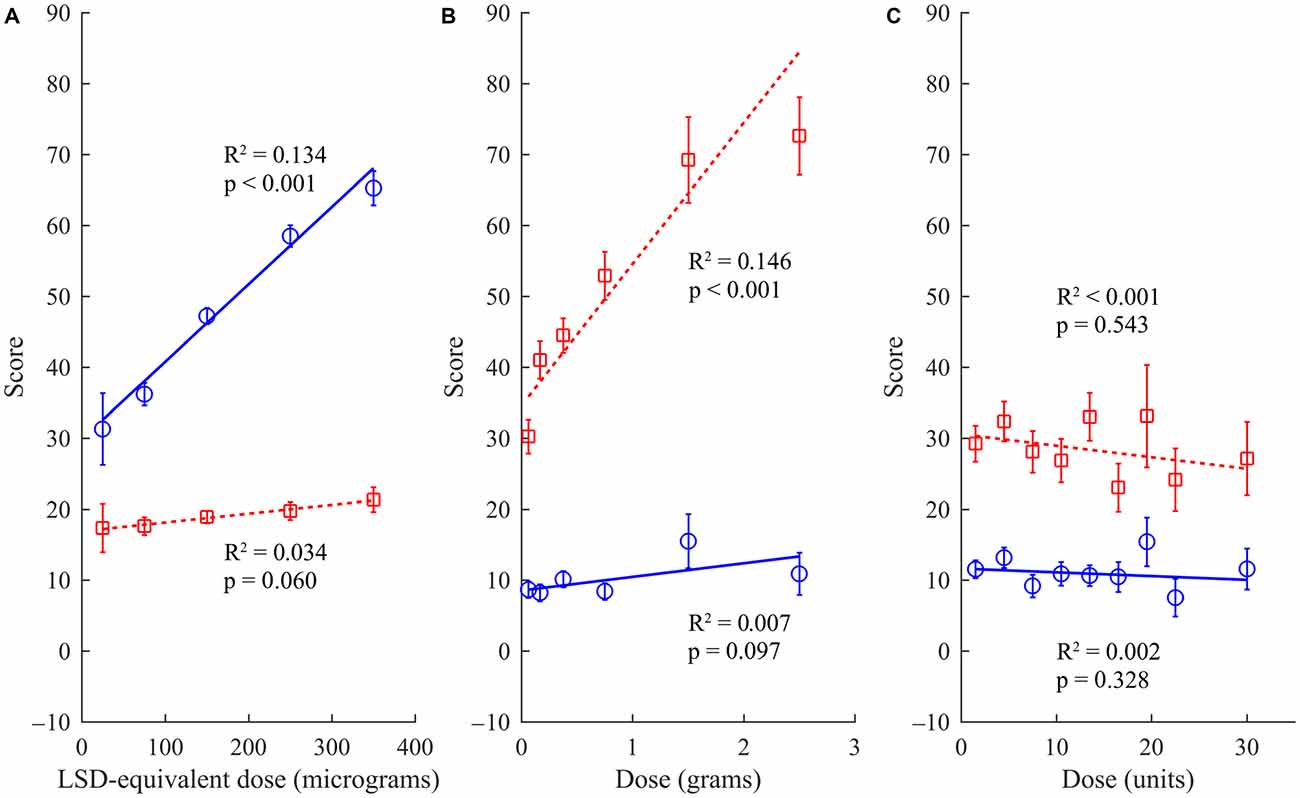
FIGURE 1. RELATIONSHIP BETWEEN DRUG DOSE AND SCORES FOR EGO DISSOLUTION (BLUE CIRCLES, SOLID LINE) AND EGO INFLATION (RED SQUARES, DASHED LINE) FOR EXPERIENCES CAUSED BY DIFFERENT CLASSES OF DRUGS. (THE) Psychedelic experiences ( n = 1043). (B) Experiences with cocaine ( n = 377). (W) Experiences with alcohol ( n = 408). The lines represent best-fit linear regression lines, with R 2 and value p correspondents. The error bars represent ±1 SEM.
Intensity-Response Relationship
For experiences with psychedelic drugs, the subjective intensity of the experience was positively correlated with ego dissolution (rho = 0.577 [0.529, 0.621]). p < 0.001) and ego inflation (rho = 0.099 [0.040, 0.159], p = 0.001), although the correlation with ego dissolution was significantly stronger than with ego inflation ( t (1040) = 15.1, p < 0.001). However, the opposite pattern was observed for experiences with cocaine and alcohol, where there was a significantly stronger correlation between the subjective intensity of these drug experiences and ego inflation (Cocaine: rho = 0.545 [0.464, 0.625]). p < 0.001. Alcohol: rho = 0.502 [0.410, 0.582], p < 0.001) than ego dissolution (Cocaine: rho = 0.279 [0.180, 0.378], p < 0.001. Alcohol: rho = 0.334 [0.237, 0.421], p < 0.001); ( t (374) = 5.33 p < 0.001 et (405) = 4.03 p < 0.001, for cocaine and alcohol, respectively) .
ANCOVA analysis was used to fit separate regression lines relating subjective intensity (predictor variable) to ego dissolution or inflation (dependent variables), for each drug class separately. This analysis confirmed that ego dissolution experiences were significantly predicted by the intensity of the experience ( F (1.1822) = 528.4, MSE = 165132.7, p < 0.001), drug class ( F (2,1822) = 636.39, MSE = 198863.7 p < 0.001), and the interaction between subjective intensity and drug class ( F (2,1822) = 116.29, MSE = 36338, p < 0.001). Follow-up multiple comparison tests (Tukey's HSD criterion) demonstrated that the slope of the regression line relating the intensity of the experience to ego dissolution was significantly steeper for psychedelics (unstandardized regression coefficient = 0.701 [0.640, 0.762]) than for cocaine (0.135 [0.088, 0.182]) or alcohol (0.144 [0.098, 0.191], both p < 0.001). There was no difference between the slopes of the regression lines relating the intensity of the experience to ego dissolution for alcohol versus cocaine ( p = 0.984; Figure 2A ).
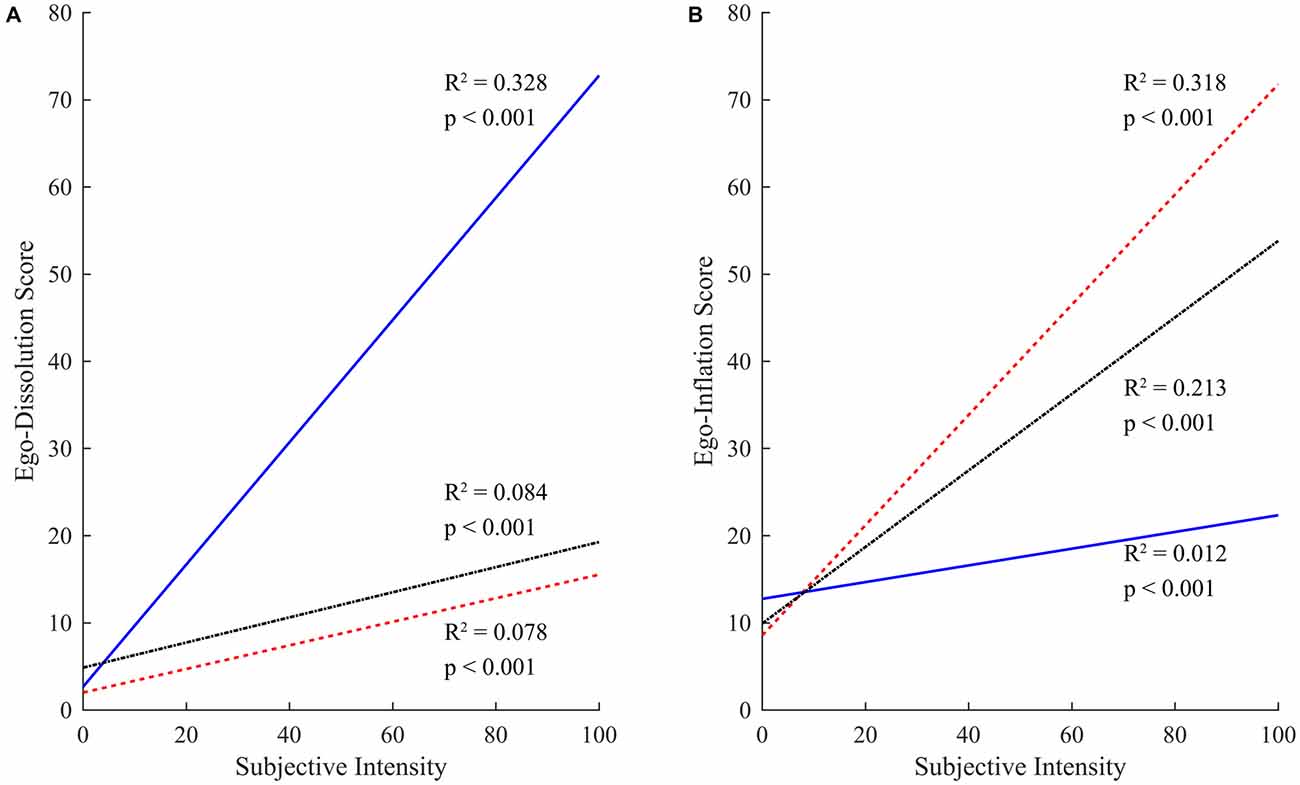
FIGURE 2. RELATIONSHIP BETWEEN THE INTENSITY OF EXPERIENCE AND EGO CONSCIOUSNESS. (THE) Best-fit linear regression lines for the relationship between reported subjective intensity and ego dissolution for psychedelic drug-induced experiences (solid blue line, R 2 = 0.328 p < 0.001), cocaine (roughly broken red line, R 2 = 0.078 p < 0.001) or alcohol (finely broken black line, R 2 = 0.084 p < 0.001). (B) Best-fit linear regression lines for the relationship between reported subjective intensity and ego inflation for psychedelic drug-induced experiences (solid blue line, R 2 = 0.012 p < 0.001), cocaine (broken red line, R 2 = 0.318 p < 0.001) or alcohol (broken black line, R 2 = 0.213 p < 0.001).
Experiences of ego inflation were also significantly predicted by subjective intensity ( F (1.1822) = 229.16, MSE = 89120.9, p < 0.001), drug class ( F (2,1822) = 278.5, MSE = 108309.5, p < 0.001) and the interaction between drug class and intensity ( F (2,1822) = 61.16, MSE = 23785.8 p < 0.001). The slope of the regression line relating the intensity of the experience to ego inflation was, however, significantly lower for psychedelics (0.096 [0.043, 0.149]) compared with cocaine (0.632 [0.538, 0.726], p < 0.001) and alcohol ( 0.439 [ 0.357, 0.521] p < 0.001) and was steeper for cocaine experiences than for alcohol ( p = 0.003; Figure 2B ).
Support Vector Machine Classifier
As a final demonstration of the specificity of the ego dissolution experience for psychedelic drugs, we trained a binary SVM classifier to distinguish between typical psychedelic ( n = 459), cocaine ( n = 377) and alcohol ( n = 408) drug experiments using only ego dissolution and inflation scores. This classifier achieved 90.1% accuracy in distinguishing between psychedelic experiences versus cocaine experiences (receptor-operator characteristic (ROC) area under the curve (AUC) = 0.958) and 85.2% accuracy in distinguishing between psychedelic and alcoholic experiences (ROC AUC = 0.927). On the other hand, it performed poorly in distinguishing between cocaine and alcohol experiences (63.4% accuracy, ROC AUC = 0.685). Classification at the random level is equivalent to 50% accuracy and ROC AUC = 0.5. The Figure 3 This illustrates the relationship between ego dissolution and ego inflation in experiences induced by different drugs.
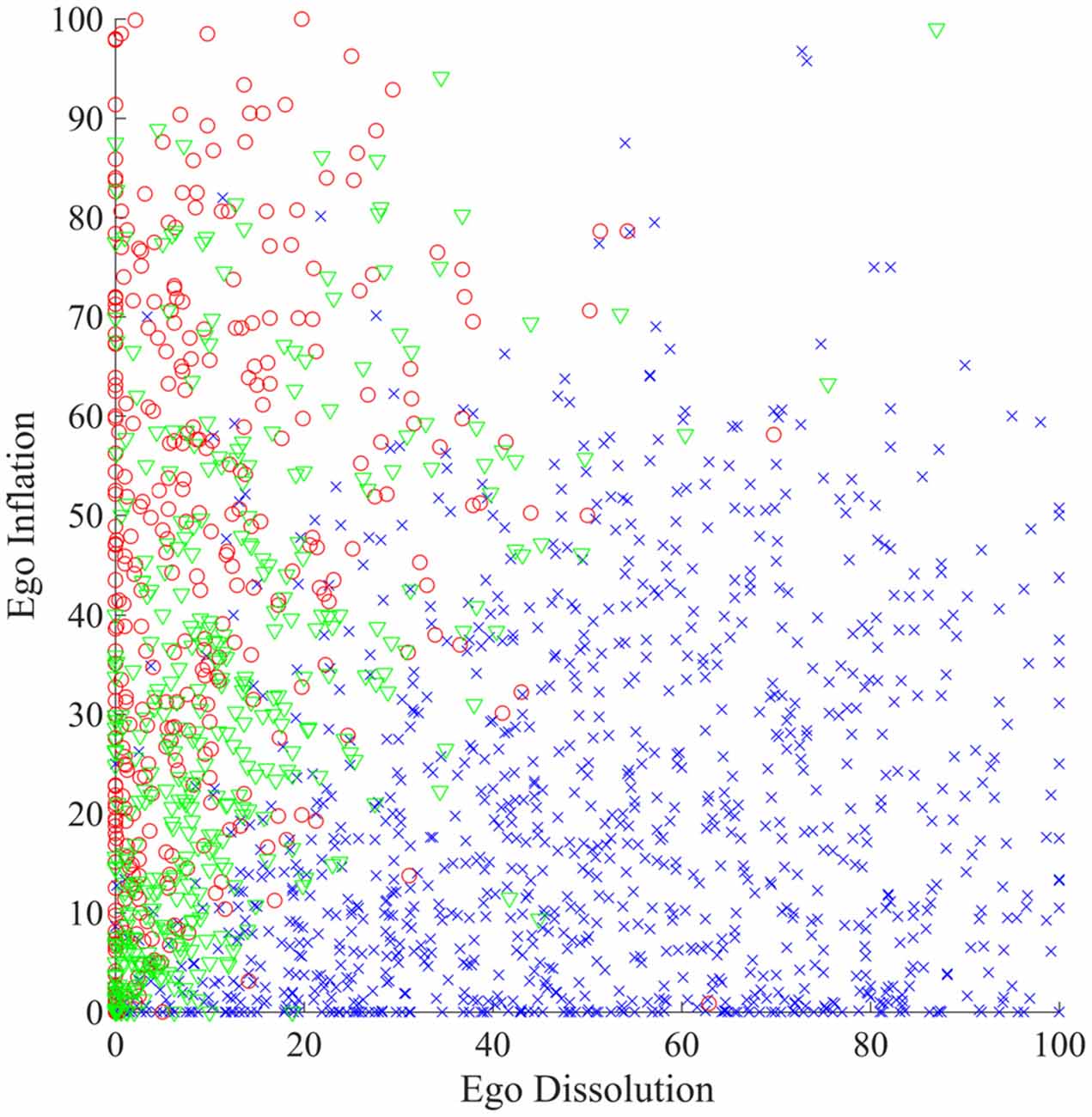
FIGURE 3. THE RELATIONSHIP BETWEEN EGO DISSOLUTION AND EGO INFLATION FOR EXPERIENCES CAUSED BY CLASSIC PSYCHEDELICS (BLUE CROSSES), COCAINE (RED CIRCLES), AND ALCOHOL (GREEN TRIANGLES) .
Ego Dissolution and Well-being
As a final exploratory analysis, we sought to investigate the relationship between ego experiences and the extent to which the experience in question changed the subjects' current sense of personal well-being or life satisfaction. For psychedelic drugs, the median response on the 7-point rating scale (with possible responses from -3 to +3) was +2 (+2 = "Moderately increased", interquartile range = 2, skewness = -0.769, mean time elapsed since experience = 1–5 years), which was significantly higher than the median response for cocaine (0 = "No change", interquartile range = 0, skewness −0.135, mean time elapsed since experience = 1–5 years) or alcohol (0 = "No change", interquartile range = 0, skewness = −0.220, mean time elapsed since experience = 1–4 weeks; p < 0.001 for both comparisons (Wilcoxon rank-sum test). The difference in average change in well-being between cocaine and alcohol was not significant. p = 0.260, Wilcoxon rank-sum test).
There was a trend of positive correlation between ego dissolution scores and improved well-being across all drug classes, with this effect reaching statistical significance after correction for multiple comparisons only for experiences induced by psychedelic drugs (psychedelic: rho = 0.392 [0.342, 0.442]). p < 0.001, cocaine: rho = 0.103 [−0.006, 0.204], p = 0.045; alcohol: rho = 0.084 [−0.009, 0.181], p = 0.091). This correlation was significantly stronger for psychedelic drugs compared to cocaine ( Z = 5.15 p < 0.001) or alcohol ( Z = 5.63 p < 0.001), but did not differ between cocaine and alcohol drug experiences ( Z = 0.267 p = 0.789).
Ego inflation was positively correlated with improved well-being for psychedelic drugs (rho = 0.198 [0.135, 0.263]). p < 0.001). However, there was a trend toward a negative correlation between ego inflation and well-being for experiences with cocaine and alcohol, although these correlations were not significant after correction for multiple comparisons (Cocaine: rho = −0.083 [−0.198, 0.027]). p = 0.107. Alcohol: rho = −0.112 [−0.216, −0.014], p = 0.024). While the correlation between ego inflation and well-being was significantly different for psychedelic drugs compared to cocaine ( Z = 4.71 p < 0.001) and alcohol ( Z = 5.53 p < 0.001), was not significantly different between cocaine and alcohol ( Z = 0.408 p = 0.683).
For psychedelic experiences, the positive correlation between ego dissolution and increased well-being was stronger than that between ego inflation and changes in well-being. t (1040) = 5.48 p < 0.001). For the cocaine and alcohol experiments, the negative correlation between ego inflation and change in well-being was stronger than the correlation between ego dissolution and change in well-being (Cocaine: t (374) = 3.14, p = 0.001 . Alcohol : t (405) = 4.13 p < 0.001).
Discussion
The results presented in this study demonstrate the internal consistency, single-factor psychometric structure, and construct validity of the EDI, a novel 8-item self-report questionnaire designed to measure the experience of ego dissolution. Furthermore, our results demonstrate that ego dissolution correlates positively with drug dose and intensity of experience specifically for psychedelic drugs, compared to experiences with cocaine or alcohol. This result reflects the previously demonstrated positive relationship between psilocybin dose and altered states of consciousness, including "oceanic boundlessness" and "fear of ego dissolution" (as measured by the 5D-ASC questionnaire; Hasler et al., 2004 ; Wittmann et al., 2007 ; Studerus et al., 2011 ) and the mystical experience ( Griffiths et al., 2011 ). In fact, we also found a positive correlation between the psychedelic dose and the unitive experience (rho = 0.307, p < 0.001).
The experience of a coherent and well-defined self is a fundamental characteristic of adult human awakened consciousness. Carhart-Harris and Friston, 2010 ; Carhart-Harris et al., 2014 ). On the other hand, the experience of ego dissolution is unfamiliar to most people and is related to relatively rare altered states of consciousness, such as the psychedelic experience ( Huxley, 1954 ; Leary et al., 1964 ; Grof, 1980 ; Harrison, 2010 ; Carhart-Harris et al., 2014 ; Lebedev et al., 2015 ) and the mystical experience ( Stace, 1960 ; James, 1985 ). Despite the relative rarity of the ego dissolution experience, a more complete understanding of its neurobiological correlates may inform our understanding of the therapeutic mechanism of action of psychedelic drugs. Grof, 1980 ; Griffiths et al., 2008 , 2011 ) and human consciousness in general ( Carhart-Harris et al., 2014 ). The development and validation of EDI is an important contribution to this research program.
An understanding of the neurobiological correlates of self-experience is also of great importance for a range of mental health conditions in which the sense of identity is disrupted or compromised. Northoff, 2014 ). An interrupted sense of self has been considered a central phenomenological feature of acute psychosis. Federn, 1952 ; Laing, 1959 ; Fischman, 1983 ; Jaspers, 1997 ; Scharfetter, 1981 ; Nour and Barrera, 2015 ). Recently, this idea has been extended by Sass and Parnas (2003) , who propose that the central phenomenological alteration in schizophrenia is a “instability of pre-reflective self-awareness” , which has been termed “self-consciousness disorder” or “self-disorder” ( Sass et al., 2011 ). They argue that saturating all subjective experience is a pre-reflective awareness of oneself as the unified subject of experience ( Sass and Parnas, 2003 ). This notion is closely related to the feeling of inhabiting a living body embedded in the world ( Stanghellini, 2009 ). Since the pre-reflective sense of self is related to a feeling of immersion in a social world, ipseity disorder can also result in deficits in social cognition observed in patients ( Parnas and Bovet, 1991 ; Stanghellini, 2001 , 2009 ; Nelson et al., 2009 ; Nordgaard and Parnas, 2014 ; Nour and Barrera, 2015 ). More research is needed to clarify the relationship between the self-disturbances observed in schizophrenia and psychedelic states, as well as the relationship between other characteristics of the psychedelic state and psychosis. Corlett et al., 2009 ).
Our results represent a necessary step in demonstrating the validity of the ego dissolution construct. Construct validity can be broken down into discriminant and convergent validity. The discriminant validity of the EDI was demonstrated by the fact that items related to ego dissolution and those related to ego inflation were loaded onto two orthogonal factors in the exploratory factor analysis. The convergent validity of the EDI was demonstrated by the strong positive correlation between the EDI and our (MEQ-based) measure of unitive experience. This suggests that experiences of ego dissolution, unity, and dissolved ego boundaries may be conceptually inseparable. Federn, 1952 ; Savage, 1955 ; Fischman, 1983 ), occurring together during psychedelic “peak” experiences. Consistent with this hypothesis, the item “I felt one with the universe” carried particularly strong weight in the “ego dissolution” factor (0.830), along with items explicitly referring to the “dissolution” and “disintegration” of the self or ego (0.883 and 0.897, respectively).
Our measure of ego inflation, as opposed to ego dissolution, showed a significant dose-response relationship with cocaine, but not with psychedelics or alcohol. Although all three classes of drugs showed a positive correlation between ego inflation and the intensity of the experience, this relationship was strongest for cocaine and weakest for psychedelic drugs. These results suggest that cocaine-induced experiences are, in a sense, antithetical to the psychedelic experience; with cocaine appearing to promote egocentrism rather than the selflessness associated with psychedelics.
Consistent with this hypothesis, a binary SVM classifier was able to identify experiences caused by psychedelic drugs versus cocaine or alcohol with over 85% accuracy using only ego dissolution and inflation scores. This machine learning approach can be usefully applied in various contexts. For example, it can help inform debates about whether hybrid compounds like 3,4-methylenedioxymethamphetamine (MDMA) should be classified as "ego-dissolving" psychedelic agents, "ego-inflating" stimulant-like agents, both, or neither. Furthermore, when used in conjunction with neurobiological measures such as neuroimaging, these tools can help us identify key (defining) properties of different psychoactive drugs, as well as non-drug-induced states, in a data-driven manner, and can inform new hypotheses about the endogenous role of 5-HT. receptors 2A. This can help us address questions regarding the similarities and differences between different altered states of consciousness, such as dreaming, psychosis, and the psychedelic state ( Carhart-Harris, 2007 ). More generally, our results suggest that the specific way in which a drug disrupts ego consciousness may inform a new phenomenologically based classification system for psychoactive substances.
Participants in this study reported that, on average, their reported experiences with psychedelic drugs had a positive and lasting impact on their well-being, which correlated positively with the degree of ego dissolution experienced (rho = 0.392). This is consistent with previous work, which established that the mystical (or “peak”) experiences induced by psilocybin correlate positively with increases in “openness” ( MacLean et al., 2011 ), well-being ( Barrett et al., 2015 ), and the spiritual meaning/significance of the experience ( Griffiths et al., 2008 ). Similarly, an influential model of LSD therapy states that the experience of “ego death and… loss of boundaries between the subject and the objective world, with consequent feelings of unity” is of great therapeutic benefit. Grof, 1980 ). Furthermore, lifetime use of psychedelics has been associated with a reduced odds ratio for psychological distress, suicide, and certain mental health problems in large population samples ( Krebs and Johansen, 2013 ; Hendricks et al., 2015 ; Johansen and Krebs, 2015 ).
Regarding the neurobiology of the psychedelic state, previous work has indicated that psychedelics disrupt the integrity of the default mode network (DMN), a normally well-integrated network of brain regions (primarily cortical) that exhibit high metabolic demands, “connector-hub” status, and appear to be involved in high-level functions such as the processing of self-specific information ( Qin and Northoff, 2011 ; Buckner, 2013 ; Speth et al., 2016 ). Psilocybin and ayahuasca containing DMT decrease the functional connectivity between the main central regions of the DMN ( Carhart-Harris et al., 2012 ; Muthukumaraswamy et al., 2013 ; Palhano-Fontes et al., 2015 ). Psilocybin and LSD also disrupt the functional segregation between generally well-defined brain networks, promoting greater overall integration ( Carhart-Harris et al., 2013 ; Roseman et al., 2014 ), which correlates with the dissolution of the ego ( Tagliazucchi et al., 2016 ). Disrupted DMN integrity and reduced anticorrelation between DMN and task-positive network activity may facilitate a less constrained cognitive style and a weakening of the feeling of a well-defined self. This may be a psychological consequence of a less restricted (more entropic) style of brain activity and a “collapse” in the normal hierarchical organization of cortical circuits, which normally functions to enhance perception and cognition by minimizing uncertainty ( Hohwy, 2007). ; Carhart-Harris and Friston, 2010 ; Friston, 2010 ; Carhart-Harris et al., 2014 ; Roseman et al., 2014 ; Tagliazucchi et al., 2014 ; Nour and Nour, 2015 ).
These previous experimental findings suggest that the integrity of the DMN may be important for normal self-experience ( Qin and Northoff, 2011 ; Carhart-Harris et al., 2014 ). Relatively few studies have explicitly investigated the neural correlates of ego dissolution experiences induced by psychedelic drugs. Muthukumaraswamy et al. (2013) They found that the ego disintegration experience caused by psilocybin correlated with decreased alpha power in the posterior cingulate cortex, a region of the DMN hub, using magnetoencephalography (MEG). Lebedev et al. (2015) on the other hand, found that ego dissolution correlated with decreased functional connectivity between the anterior parahippocampal cortex and higher-level cortical DMN regions, as well as decreased integrity (within the network) of the salience network and reduced interhemispheric communication.
A recent study found that the degree of ego dissolution caused by LSD was correlated with overall functional connectivity (“Functional Connectivity Density,” measured by functional magnetic resonance imaging (fMRI)) in the bilateral temporoparietal junction (angular gyrus) and bilateral insular cortex ( Tagliazucchi et al., 2016 ). More generally, this study reported that LSD induced increases in global connectivity in more widespread high-level association cortices that substantially overlap the standard-mode network. A separate analysis of the same fMRI data further revealed that ego dissolution showed a strong inverse correlation with DMN network integrity (measured as resting-state functional connectivity within the network) and functional connectivity between the parahippocampus and the retrosplenial cortex (Carhart-Harris et al.). al., 2016 ). Furthermore, significant relationships were found between ego dissolution and decreased delta and alpha power (e.g., in the posterior cingulate cortex) as measured by MEG ( Carhart-Harris et al., 2016 ), replicating previous findings with psilocybin ( Muthukumaraswamy et al., 2013 ).
One limitation of these studies is that they used a single-item measure of ego dissolution ( Muthukumaraswamy et al., 2013 ; Carhart-Harris et al., 2016 ; Tagliazucchi et al., 2016 ) or principal component analysis loads from a (still) unvalidated questionnaire that included items indirectly related to ego dissolution (e.g., perceptual abnormalities; Lebedev et al., 2015 ). Thus, the validated EDI allows for a more rigorous study of the neural correlates of ego dissolution experienced in various altered states of consciousness, including those associated with psychedelic drugs and spiritual practice.
This study has some limitations. First, the sampled population was quite homogeneous, which limits the external validity of the study and therefore our ability to extrapolate to a broader demographic group. Specifically, the majority of our subjects were male, under 30 years old, and had at least some college education. More than half of the participants had used classic psychedelic drugs on more than 10 occasions. This also raises the possibility that our subjects' responses were influenced by their familiarity with accounts of paradigmatic features of the psychedelic experience, such as ego dissolution. Furthermore, we did not collect information about the setting in which the psychedelic experiences took place, which is known to influence the quality of the experience ( Leary et al., 1964 ; Grof, 1976 ; Fischman, 1983 ). Another important limitation of our study is its retrospective design, which introduces potential inaccuracies in the recall of experiences. We used an anonymous online questionnaire to facilitate the collection of a large sample of data from individuals around the world. While this approach has its strengths, it is impossible to verify whether the experiences attributed to psychedelics were in fact caused by these substances. Finally, we asked participants to estimate the dose of psychedelic ingested using doses "equivalent to LSD," in order to more easily investigate dose-response relationships between different classic psychedelics. The imprecision introduced by this approach, however, likely weakened, rather than strengthened, any observed dose-response relationship between psychedelics and ego dissolution.
Given these limitations, future studies should include a more heterogeneous sample population, perhaps intentionally recruiting individuals from different cultural and religious backgrounds, to explore the influence of these factors on ego dissolution. It would also be interesting to investigate the relationship between the responses on the EDI and other validated scales, for example, the 5D-ASC ( Studerus et al., 2010 ). Finally, experimental studies in which a variety of doses of psychedelic drugs are administered to subjects in a blinded manner would be able to assess how subject-specific factors influence the relationship between dose and subjective effects, while controlling for recall effects and the setting effect.
In conclusion, the present study offers validation of the initial phase of EDI and adds to the growing evidence that ego dissolution is a key phenomenological feature of the psychedelic experience, which can be studied experimentally. The existence of the EDI will facilitate future research on the neural correlates of this experience, which is relevant to psychedelic-assisted psychotherapy and the phenomenology of certain psychiatric conditions.
Author's contributions
MMN and RLC-H conceived and designed this study and interpreted the results; contributed to the writing of the work and critically reviewed it for important intellectual content. All authors have approved the final version of this manuscript for publication and have agreed to be responsible for all aspects of the work, ensuring that questions relating to the accuracy or integrity of any part of the work are properly investigated and resolved. MMN and LE performed the statistical analysis of the data. LE managed the application of the questionnaire and subsequent data collection. MMN wrote the article, with editing by RLC-H.
Financing
MMN is funded by the Medical Research Council, United Kingdom. RLC-H is funded by the Mosley Foundation. DN is funded by the Safra Foundation.
Declaration of conflict of interest
The authors declare that the research was conducted in the absence of any commercial or financial relationships that could be interpreted as a potential conflict of interest.